
Safety Labels & Safety Signs
You have probably seen many different types of safety signs ranging from Exit signs to Emergency Stop button placards. But do you still see them when you look? Many times when we see the same things day after day, they tend to blend into the background and loose their intended effect.
We may forget to ensure adequate explanations of the types and meanings of these signs has been given to new employees. Over time safety signs may fade or become damaged such that they are no longer "readable". OSHA has some specific requirements for the design, placement and types of signs required to notify employees and visitors of hazards and dangerous areas and operations at our facility.
Purpose of Signs: Safety signs provide important specific safety information from warning of dangers, providing instructions and types of personal protective equipment needed. Signs also warn of areas that require special authorization for entry such as confined spaces and service utility areas.
Danger Signs: These signs warn of specific dangers and radiation hazards. OSHA requires that all Danger Signs be of the same type of design. A danger sign should be very obvious to all. Employees must be instructed that danger signs indicate immediate danger and that special precautions are necessary. Danger signs have red as the predominating color for the upper panel; black outline on the borders; and a white lower panel for additional back letter wording.
Caution Signs: Caution signs are used only to warn against potential hazards or to caution against unsafe practices. All employees must be instructed that caution signs indicate a possible hazard against which proper precaution should be taken. Caution signs have yellow as the predominating color; black upper panel and borders: yellow lettering of "caution" on the black panel; and the lower yellow panel for additional sign wording. Black lettering is used for additional wording.
Safety Instruction Signs: Safety instruction signs shall be used where there is a need for general instructions and suggestions relative to safety measures. These signs have a white background with black letters or white letters on a green panel
Sign Design: All signs must have rounded or blunt corners and be free from sharp edges, burrs, splinters, or other sharp projections. The ends or heads of bolts or other fastening devices must be located so that they do not create a hazard.
Nature of wording: The wording of any sign should be easily read with sufficient information to be easily understood. The wording should make a positive, rather than negative suggestion.
Construction Sites: Safety Signs and symbols required must be visible at all times when work is being performed, and shall be removed or covered promptly when the hazards no longer exist.
All materials in the members area for this topic index
[includeme file=”scripts/sdl.php” value=”/Posters/”]

GET INSTANT ACCESS
to THE MEMBERS LIBRARY
Safety materials created by safety professionals.
Access to the Safety Manager software.
Wide variety of safety videos and courses.
**Brand New** Safety Training Management System
Pre-Made Safety Materials Ready For Use
Created by experienced safety professionals & risk consultants. Saving you time, money, and risk of injuries.
95% of the work already done.
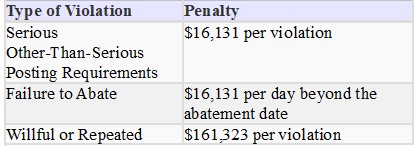
Below are the maximum penalty amounts, with the annual adjustment for inflation, that may be assessed after Jan. 15, 2024. (See OSHA Memo, Jan. 8, 2024).
**New OSHA HEAT 90 DAY**
>>Download Free HERE<<
**New 2024 OSHA 300 Form**
>>Download Free HERE<<
**Brand New**
Free with full membership subscription
Training LMS System
Ask The Safety Consultant
Safety Equipment Deal Finder

“SafetyInfo.com is the first go-to website for safety professionals and companies to use in establishing a solid safety program"
-Mike McKenzie, Certified Safety & Health Manager (CSHM), McSafety Solutions™
Note: You must have a full subscription to the Safety Library in order to use this material. Any use outside of your organization, for resell, or without an active membership is strictly prohibited and may result in prosecution under copyright infringement laws. Please contact us first, if you would be interested in reselling or using our materials for reproduction.
Inside the Members Library
Topic Index
Accident Prevention
Air Quality
Asbestos
Bloodborne Pathogens
Boilers
Chemical Safety
Compressed Gas
Confined Space
Construction
Construction Worksite
Cranes & Slings
Driver / Fleet Safety
Drug Free Workplace
Electrical
Emergency Management
Engineering Safety
Environmental
Equipment
Ergonomics
Fall Protection
Fire Safety & Prevention
First Aid
Flammable Materials
Forklifts
Hazard Communication
Hazardous Materials
Hearing Protection
Heat Stress
Hot Work
Housekeeping
Job Safety Analysis
Laboratory
Ladders
Lead
Lockout-Tagout
Machinery & Equipment
Material Handling
MSDS (SDS)
Medical & First Aid
Occupational Health
Office Safety
Off the Job Safety
Personal Protection
Process Safety
Record Keeping
Respiratory Protection
Silica Safety
Rules & Policies
Signs & Labels
Slips, Trips & Fall
Training
Terrorism Programs
Tool Safety
Vehicle & Driver
Violence Programs
Welding & Hot Work
Training Videos
Library Index
Training Materials
Videos/Courses
Talks
Articles
PowerPoint
Handouts
Training Overheads
Quizzes
Supervisor Briefs
Management Briefs
Safety Sessions
2 Minute OSHA Safety Talks
Pamphlets
First Aid Training
Supervisor Training
Hazardous Materials
Bomb Threat
Crossword Puzzles
Biological Agents
Forms & Documents
Forms
Checklists
Audit Guides
Inspections Guides
Signs & Labels
Environmental Audit Guides
Recordkeeping - OSHA 300
Sign & Label Maker
Safety Management Resources
Safety Manuals/Written Programs
Ergonomic Programs
Emergency Plans
Process Safety Management
Construction Safety
Occupational Health
Environmental
Topic Sheets
DOT Fleet-Driver
Hazardous Materials
Chemical Safety
Drug Free Workplace
Terrorism Programs
Development Guides
Safety Manager Software
Safety References & Graphics
Technical Safety Information
Posters
Topic & Fact Sheets
Development Information
Job Specific Safety Rules
Terrorism
Calculators
Safety Comic Strips
New Safety Training System
Schedule and train your employees with our materials. Add unlimited amount of employees. Record all progress and issue certificates. For group and individual training sessions.
All materials in the members area for this topic index
| Program Material |
| Program Development |
| Safety Signs |
| Fact Sheet |
| Safety Signs |
| HMIS Labels |
| NFPA Labels |
| Forms & Documents |
| Safety Signs Checklist |
| Safety Sign & Label Maker Program & Templates |
| Training Material |
| Outline |
| Safety Signs |
| Handout |
| Web Page, MS Word, PDF Version |
| Overheads |
| Safety Signs & Labels |
All materials in the members area for this topic index
Your content here...